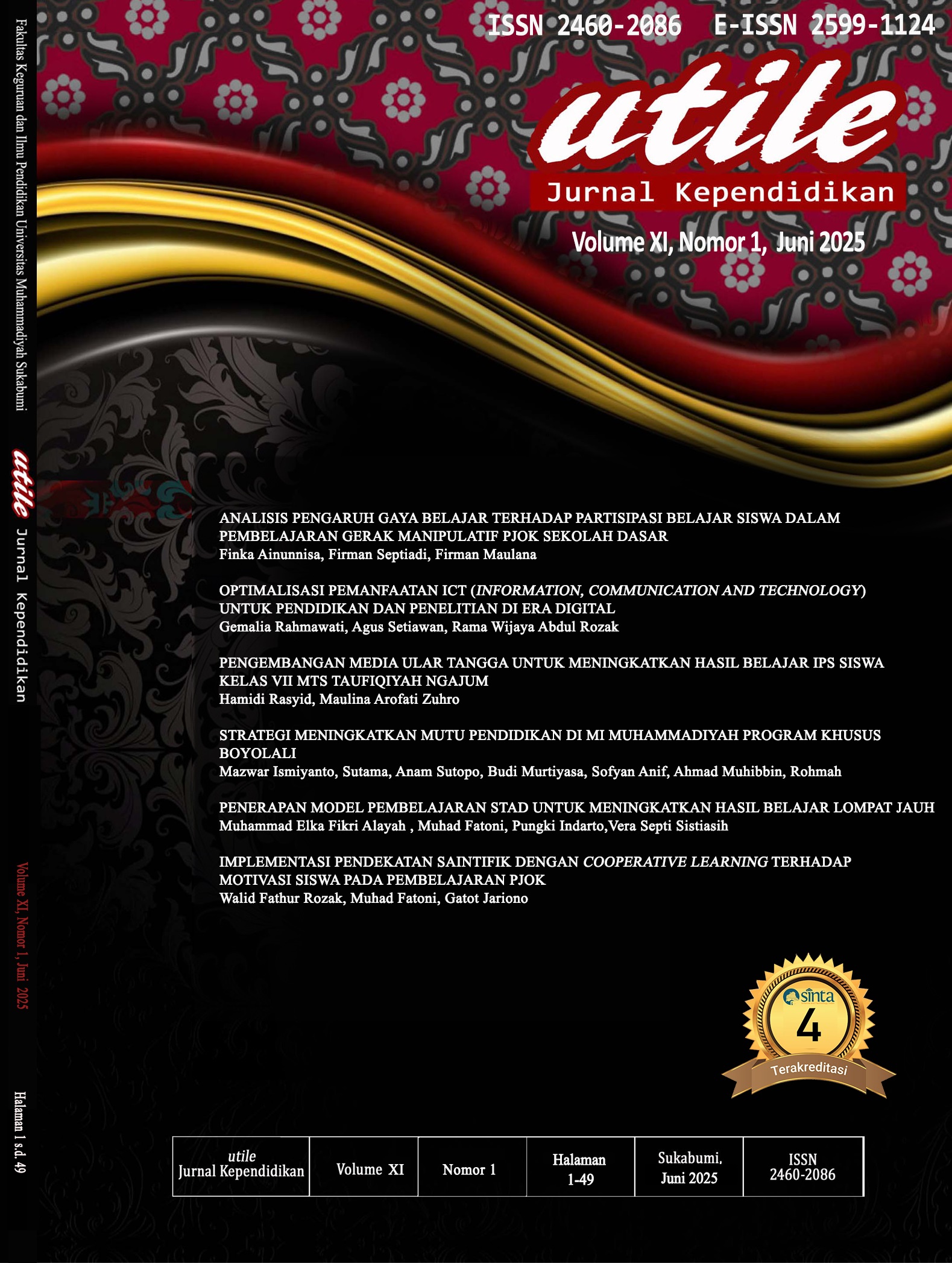
Strategi Meningkatkan Mutu Pendidikan di Mi Muhammadiyah Program Khusus Boyolali
DOI:
https://doi.org/10.37150/5x1vf345Keywords:
Strategi, Mutu Pendidikan, MI Muhammadiyah PK BoyolaliAbstract
Penelitian ini bertujuan untuk mengidentifikasi dan menganalisis strategi yang efektif dalam meningkatkan mutu pendidikan di MI Muhammadiyah Program Khusus Boyolali. Teknik pengumpulan data dilakukan dengan cara melakukan wawancara, observasi, dan dokumentasi, hasil dari pengumpulan data akan diolah secara kualitatif. Hasil dari penelitian ini menemukan bahwa strategi meningkatkan mutu melalui kurikulum dengan cara menerapkan kurikulum yang berlaku dan ditambahkan pengembangan al islam dan kemuhammadiyahan, Peran kepala sekolah yang inovatif, mengayomi, dan mendukung madrasah, Meningkatkan kualitas guru dan karyawan melalui seminar, pelatihan, dan kompetisi atau lomba, Akademik siswa didukung dengan menggunakan metode pembelajaran yang kreatif dan interaktif, dan meningkatkan sarana prasarana yang mendukung kegiatan belajar di madrasah, serta perlu adanya pengembangan bangunan madrasah yang nyaman.
References
Anwar, A. (2017). Pengembangan Kurikulum Berbasis Kompetensi di Sekolah Menengah Kejuruan, Jakarta: Kencana.
Creemers, B., & Kyriakides, L. (2008). The dynamics of educational effectiveness: A contribution to policy, practice and theory in contemporary schools. Routledge. https://doi.org/10.4324/9780203939185
Darling-Hammond, L. (2017). "Teacher Education around the World: What Can We Learn from International Practice?"
European Journal of Teacher Education, 40(3), 291- 309.https://doi.org/10.1080/02619768.2017.1315399
Darling-Hammond, L., Flook, L., CookHarvey, C., Barron, B., & Osher, D. (2020). Implications for educational practice of the science of learning and development. Applied Developmental Science, 24(2), 97-140. https://doi.org/10.1080/10888691.2018.1537791
Departemen Pendidikan Nasional. (2007). Undang-Undang Republik Indonesia Nomor 20 Tahun 2003 tentang Sistem
Pendidikan Nasional. Jakarta: Departemen Pendidikan Nasional.
Desty (Guru), wawancara oleh Mazwar, MI Muhammadiyah PK Boyolali. Tanggal 20 Januari 2024.
Egalite, A. J., & Kisida, B. (2018). The effects of teacher match on students' academic perceptions and attitudes. Educational 33 Evaluation and Policy Analysis, 40(1), 59-81. https://doi.org/10.3102/0162373717714056
Epstein, J. L. (2011). "School, Family, and Community Partnerships: Preparing Educators and Improving Schools." Westview Press.
Epstein, J. L. (2018). School, family, and community partnerships: Preparing educators and improving schools.
Routledge. https://doi.org/10.4324/9780429494673
Gumus, S., Bellibas, M. S., Esen, M., & Gumus, E. (2018). A systematic review of studies on leadership models in educational research from 1980 to 2014. Educational Management Administration & Leadership, 46(1), 25-48. https://doi.org/10.1177/1741143216659296
Hallinger, P. (2018). Bringing context out of the shadows of leadership. Educational Management Administration &
Leadership, 46(1), 5-24. https://doi.org/10.1177/1741143217733366
Hallinger, P., & Kulophas, D. (2020). The evolving knowledge base on leadership and teacher professional learning: A
bibliometric analysis of the literature, 1960-2018. Professional Development in Education, 46(4), 521-540. https://doi.org/10.1080/19415257.2019.1623287
Hamalik, O. (2010). Proses Belajar Mengajar. Jakarta: PT Bumi Aksara, 2010. Hanushek, E. A. (2011). The economic value of higher teacher quality. Economics of Education Review, 30(3), 466-479. https://doi.org/10.1016/j.econedurev.2010.12.006
Hanushek, E. A., & Woessmann, L. (2017). School resources and student achievement: A review of cross-country economic research. Cognitive Abilities and Educational Outcomes, 149-171. https://doi.org/10.1007/978-3-319-43473-5_7
Hargreaves, A., & Fullan, M. (2020). Professional capital after the pandemic: Revisiting and revising classic understandings of teachers' work. Journal of Professional Capital and Community, 5(3/4), 327-336. https://doi.org/10.1108/JPCC-06-2020-0039
Hargreaves, A., Lieberman, A., Fullan, M., & Hopkins, D. (Eds.). (2010). Second international handbook of educational
change. Springer. https://doi.org/10.1007/978-90-481-2660-6
Harris, A., & Jones, M. (2019). Teacher leadership and educational change. School Leadership & Management,
39(2), 123-126. https://doi.org/10.1080/13632434.2019.1574964
Haryanto, B., & Rahayu, E. (2018). “Pengembangan Strategi Peningkatan Mutu Pendidikan di Sekolah Dasar”. Jurnal Pendidikan Dasar, 9(2), 134-144.
Hattie, J. (2009). Visible learning: A synthesis of over 800 meta-analyses relating to achievement. Routledge.
https://doi.org/10.4324/9780203887332
Leithwood, K., Harris, A., & Hopkins, D. (2020). Seven strong claims about successful school leadership revisited.
School Leadership & Management, 40(1), 5-22. https://doi.org/10.1080/13632434.2019.1596077
Liu, S., & Hallinger, P. (2018). Principal instructional leadership, teacher selfefficacy, and teacher professional learning in China: Testing a mediatedeffects model. Educational Administration Quarterly, 54(4), 501-528. https://doi.org/10.1177/0013161X18769048
Marzuki, M. (2018). Manajemen Pendidikan: Konsep dan Aplikasi. Jakarta: PT Raja Grafindo Persada.
Misbah, A., & Mustofa, A. (2017). "Pembaharuan Pendidikan Islam Muhammadiyah di Era Globalisasi." Jurnal Pendidikan Agama Islam, 5(2),123-140.
Mulyasa. (2015). Pengembangan dan Implementasi Kurikulum 2013. Bandung: PT Remaja Rosdakarya.
Murillo, F. J., & Román, M. (2011). School infrastructure and resources do matter: Analysis of the incidence of school resources on the performance of Latin American students. School Effectiveness and School Improvement, 22(1), 29-50. https://doi.org/10.1080/09243453.2010.543538
Nata, A. (2020). Implementasi Teknologi Informasi dan Komunikasi (TIK) dalam Pembelajaran. Yogyakarta: Ar-ruzz
Media, 2020.
Nurlaela, L. (2019). Pelatihan dan Pengembangan Sumber Daya Manusia Pendidikan. Jakarta: PT Raja Grafindo
Persada.
Priestley, M., Alvunger, D., Philippou, S., & Soini, T. (Eds.). (2021). Curriculum making in Europe: Policy and practice within and across diverse contexts. Emerald Publishing Limited. https://doi.org/10.1108/9781838677343
Rahman, B., Abdurrahman, A., Kadaryanto, B., & Rusminto, N. E. (2019). Teacherbased scaffolding as a teacher professional development program in Indonesia. Australian Journal of Teacher Education, 40(11), 67-78. https://search.informit.org/doi/10.3316/ielapa.593426999046885
Rahman, B., Abdurrahman, A., Kadaryanto, B., & Rusminto, N. E. (2019). Teacherbased scaffolding as a teacher professional development program in Indonesia. Australian Journal of Teacher Education, 40(11), 67-78. https://doi.org/10.14221/ajte.2015v40n11.4
Raihani, R. (2017). Education for multicultural citizens in Indonesia: Policies and practices. Compare: A Journal of
Comparative and International Education, 47(6), 850-867. https://doi.org/10.1080/03057925.2017.1339251
Reynolds, D., Sammons, P., De Fraine, B., Van Damme, J., Townsend, T., Teddlie, C., & Stringfield, S. (2014). Educational effectiveness research (EER): A state-ofthe-art review. School Effectiveness and School Improvement, 25(2), 197-230.
https://doi.org/10.1080/09243453.2014.885450
Rohmah (Kepala Sekolah), wawancara oleh Mazwar, MI Muhammadiyah PK
Boyolali. Tanggal 20 Januari 2024.
Scheerens, J. (2016). Educational effectiveness and ineffectiveness: A critical review of the knowledge base. Springer. https://doi.org/10.1007/978-94-017-7459-8
Schneider, M. (2002). Do school facilities affect academic outcomes?. National Clearinghouse for Educational Facilities.
Suryanto, A., & Suharsono, S. (2019). Analisis Strategi Meningkatkan Mutu Pendidikan di Sekolah Dasar. Jurnal Pendidikan Dasar.
Zhao, Y., Watterston, J., de Vries, M. J., Stohlmann, M., Barlex, D., & Wang, T. (2022). Technology and engineering education in the digital age. Journal of Technology and Science Education, 12(1), 1-10. https://doi.org/10.3926/jotse.1401